Spam Score
Frequently Asked Questions
What's Covered?
In this guide you’ll learn more about the Spam Score metric in Link Explorer and the Links section of your Campaign. If you need help understanding terminology used throughout the tools, please see our glossary.
Quick Links
What Is Spam Score?

Within Link Explorer, Spam Score represents the percentage of sites with similar features to the site you’re researching which we've found to be penalized or banned by Google. Spam Score is based on our machine learning model which identified 27 common features among the millions of banned or penalized sites in the data we fed it.
A score of 1%-30% is considered a Low Spam Score.
A score of 31%-60% is considered a Medium Spam Score.
A score of 61%-100% is considered a High Spam Score.
A high Spam Score for your site, or a site you're looking at, doesn't mean this site is necessarily spammy. It's a sign that you should do some more investigation into the quality and relevance of this site. Read more about how to use Spam Score.
You can access Spam Score through the Link Explorer tool, and through the Links section of your Moz Pro Campaign.
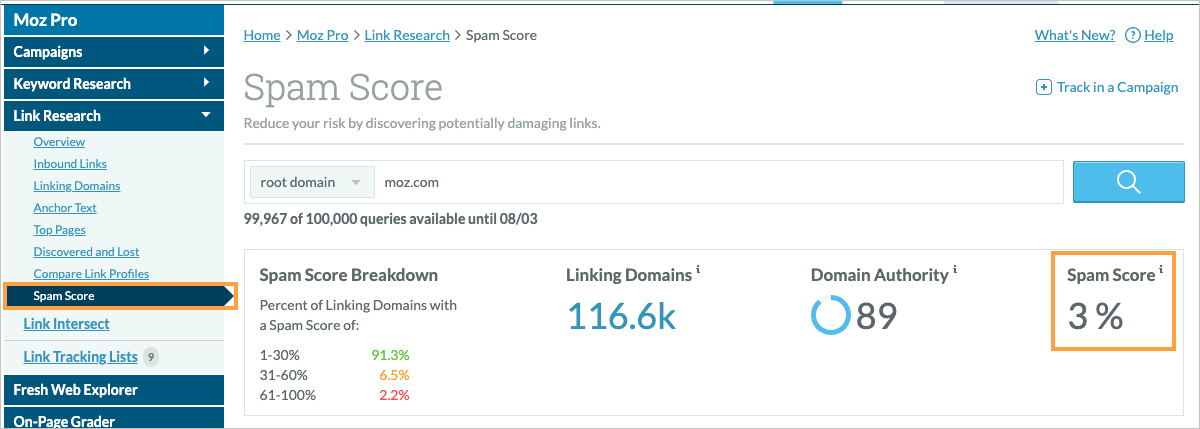
Spam Score Breakdown
The first thing you’ll see is the Spam Score on the right-hand side for the site you entered. You’ll also see a breakdown for the percentage of Linking Domains pointing to your site which fall into each Spam Score rating.
In the below example, 66.7% of the Linking Domains pointing to the queried site have a LowSpam Score of 1%-30%. The queried site itself, has a score of 28%.

Below the Spam Score Breakdown you’ll see a chart with all the inbound links for the queried site, sorted by descending Spam Score. You can export to CSV, or click on the inbound link to do some investigating.

How To Use Spam Score
Your Spam Score
This does not mean that your site is definitely spammy. The percentage represents a wide variety of potential signals ranging from content concerns to low authority metrics.
Since this is based on correlation with penalization rather than causation, the solution isn't necessarily to change these factors on your site. If you have not had any penalties you shouldn’t be concerned about a Low or Medium score. It is best to use this percentage figure to judge the quality of inbound links to your site, giving you a signal to help you determine which of those links needs some further investigation and, perhaps, even removal.
Another site's Spam Score
Again, this doesn't mean that these sites are spammy. This percentage represents a wide variety of potential signals ranging from content concerns to low authority metrics.
Since this is just based on correlation with penalization, rather than causation, the solution isn't necessarily to disregard sites or disavow links with higher Spam Scores. Instead, we'd recommend using it as a guide for kick starting investigations. Be sure to check out a site's content and its relevance in linking back to you before disregarding or disavowing.
Export Your Data
You can export your data to CSV and, when ready, your file will be available to download from the Export Notifications flag on the top right.
Spam Score Signals
We utilized machine learning and a massive set of training data, consisting of known penalized and banned domains, to identify these key signals that are correlated with sites that have been penalized or banned.
We have listed these numerically, but this number has no bearing on the importance of each signal.
Here’s a rundown of the 27 signals we use:
1. Low number of pages found Our crawlers discovered only a small number of pages on this domain. This is not an inherent problem, but many spam sites have small numbers of pages, hence the correlation.
2. TLD correlated with spam domains This domain's top-level domain extension (e.g. .info, .cc, .pl, etc) is one that many spam domains use.
3. Domain name length The length of the subdomain and root domain is similar to those used by spam sites.
4. Domain name contains numerals Like many spam sites, this domain name contains numeric characters.
5. Google Font API Present This domain does not use special fonts (e.g. Google Font API). Lacking this feature was common among spam sites we found.
6. Google Tag Manager Google Tag Manager is almost never present on spam sites.
7. Doubleclick Present The Doubleclick ad tag is almost never present on spam sites.
8. Phone Number Present Spam sites rarely have real phone numbers present on their pages.
9. Links to LinkedIn Almost no spam sites have an associated LinkedIn page, hence lacking this feature is correlated with spam.
10. Email Address Present Email addresses are almost never present on spam sites.
11. Defaults to HTTPS Few spam sites invest in SSL certificates; HTTPS is often a good trust signal.
12. Use of Meta Keywords Pages that use the meta keywords tag are more likely to be spam than those that don't.
13. Visit Rank Websites with very few visits in clickstream panels were more often spam than those with high numbers of visits.
14. Rel Canonical Utilizing a non-local rel=canonical tag is often associated with spam.
15. Length of Title Element Pages with very long or very short titles are correlated with spam sites.
16. Length of Meta Description Pages with very long or very short meta description tags are correlated with spam sites.
17. Length of Meta Keywords Pages with very long meta keywords tags are often found on spam sites.
18. Browser Icon Spam sites rarely use a favicon; non-spam sites often do.
19. Facebook Pixel The Facebook tracking pixel is almost never present on spam sites.
20. Number of External Outlinks Spam sites are more likely to have abnormally high or low external outlinks.
21. Number of Domains Linked-To Spam sites are more likely to have abnormally high or low unique domains to which they link.
22. Ratio of External Links to Content Spam sites are more likely to have abnormal ratios of links to content.
23. Vowels/Consonants in Domain Name Spam sites often have many sequential vowels or consonants in their domain name.
24. Hyphens in Domain Name Spam sites are more likely to use multiple hyphens in their domain name.
25. URL Length Spam pages often have abnormally short or long URL path lengths.
26. Presence of Poison Words Spam sites often employ specific words that are associated with webspam topics like pharmaceuticals, adult content, gaming, and others.
Beginner's Guide to SEO [Search Engine Optimization] - Moz
Welcome to your SEO learning journey! You'll get the most out of this guide if your desire to learn search engine optimization (SEO)...


No comments:
Post a Comment
Note: Only a member of this blog may post a comment.